


I built a reinsurance treaty pricing tool from standard blockr blocks, with no code and no insurance-specific adjustments. You can price a layered treaty in the deployed app.
blockr is a no-code dashboard builder for R. Builders create workflows by linking blocks together instead of writing code.
We originally built blockr together with Bristol Myers Squibb as a clinical data exploration tool, but the approach turned out to be much more general. At cynkra we have worked with insurance companies since the beginning, so I was very excited to get the chance to present to a reinsurance audience.
The treaty pricing tool that I presented was built entirely on standard blockr packages. Nothing was coded, and no insurance-specific adjustments were made. Have a look at the deployed version:
blockr.cloud/app/treaty-pricer
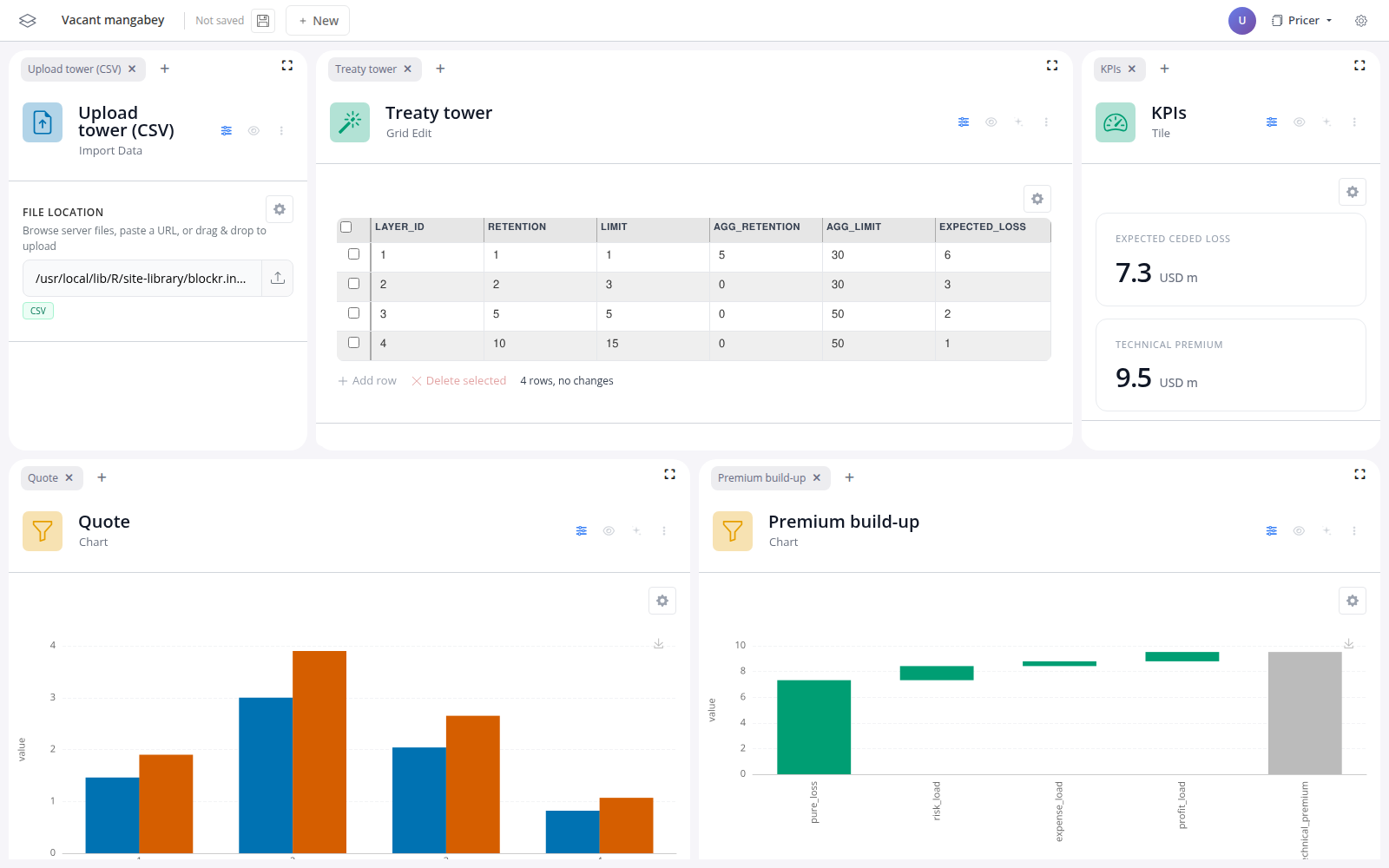
What the pricing tool does
The tool prices a layered reinsurance treaty. You edit the treaty structure (the “tower”), and it computes expected losses and technical premiums per layer. Change any number and everything downstream recomputes. The pricing is simulation-based and uses the Pareto R package by Ulrich Riegel. Thanks a lot to Luca Zamagni for the idea and helping me setting it up!
How it works
A dashboard is made of blocks. Every block is a step in an analysis: read data, transform it, draw something. You connect blocks with links, and data frames flow between them. The pricing tool is simply a collection of these generic blocks. The only place where we rely on writing R is a function block: it just runs a bit of R inside the board, here a call to the Pareto package. If that step came up a lot, we could build a proper block for it, with its own inputs.
Building by talking to it
You do not have to build a pipeline by hand. The new blockr AI assistant wires it up for you and configures the blocks. Ask it to “add a table of the priced layers showing expected loss and technical premium” and it adds the block, links it to the right place, and puts it on the page, while the rest of the board keeps running.
This is genuinely different from vibe-coding a dashboard with a code assistant. Everything the AI produces is a normal block, in plain R, that you can open and edit. When it gets something wrong, you do not debug generated code; you open the block and fix the one setting. Extending a living dashboard works the same way.
Try it
blockr is fully open source under GPL-3. You can price a treaty right now, no installation required:
blockr.cloud/app/treaty-pricer
To run the pricer in your own R session, the example page has the install and launch instructions. And to build your own dashboards from an empty board, the playground needs no install either. blockr is on CRAN, but install from GitHub for the latest experience. See blockr.site for more documentation.
The pricer is just one of several insurance applications built with blockr. You can find more, including a life-underwriting workbench and a reinsurance portfolio dashboard, on blockr.site/examples.